


The Global Mobility industry has changed profoundly since the pandemic, on both the buy-side and the supply-side. Client staffing practices have broadened well beyond formal assignment contracts to include virtual assignments, remote and hybrid roles, contractors and gig workers, while established providers, squeezed by falling household goods and home sale volumes, have had to reinvent themselves quickly alongside a wave of new tech platforms and hybrid models. The result is a genuinely more varied landscape on both sides: more types of need, more variation from the traditional types of provider.
Triggers for a procurement process remain broadly the same as ever: dissatisfaction with an incumbent, such as inconsistent service delivery or a lack of cost transparency; corporate procurement policies that mandate periodic review; or shifting geographical hiring patterns and labour market pressures. Whatever the reason, it pays to understand the options available, to ensure a good match between your requirements and the right solution.
Global Mobility teams also vary hugely - in size, maturity, geographic spread, policy complexity and internal capability. Many organisations end up with the relocation support model they inherited, rather than the one they'd actively choose if they started from scratch.
That's understandable. Relocation programmes evolve gradually, providers get renewed on autopilot, and unless something goes visibly wrong, there's rarely a natural moment to stop and ask whether the current approach still fits. But the wrong model - or the right model applied to the wrong situation - can quietly create friction: assignee complaints that pile up, inconsistent experiences across regions, or a growing sense that your provider is managing a process rather than supporting your people.
The instinct when this happens, is to ask "which model should we be using instead?" and then reviewing the company’s in that niche to evaluate providers. It's a reasonable question, but is it the wrong first question?. There is no single relocation model that's objectively "best" - and to suggest otherwise is oversimplifying. What matters far more is understanding what you actually need, and using that to judge fit - whichever combination of provider types ends up delivering it.
This piece is written for HR, Talent Mobility, Reward and Global Mobility professionals - whether you're reviewing an existing relocation programme or building one for the first time. It won't tell you which model to pick. It will help you work out what you're really solving for, so that whoever you talk to next, you're asking the right questions.
Before you compare providers, define the problem
It's tempting to start by learning the different types of relocation provider (RMC, boutique, managed network, tech platform) and try to map yourself onto one. But HR and procurement teams often recognise the symptoms of a mismatch long before they understand what's actually causing it. Slow response times, rising costs, or patchy employee feedback can be blamed on "the provider" when the real issue is a mismatch between what your programme needs and the type of support structure delivering it.
So before looking at provider types at all, it's worth asking a more fundamental question:
What are we actually trying to solve?
Is the priority:
- A better employee experience?
- Greater cost control?
- Improved compliance?
- Faster deployment?
- Better visibility and reporting?
- More flexibility for non-traditional mobility populations (virtual assignments, remote hires, contractors)?
- Greater global consistency?
Most programmes care about all of these to some degree. That's normal, and it doesn't mean the exercise fails - it means your priorities are broad rather than narrow, which is useful information in itself. The goal isn't to force a false ranking. It's to get clear, as a team, on which of these matter most right now, and which you're willing to flex on. That clarity is what makes the rest of this process and any conversation with a provider much more productive.
Are we hearing all the important voices?
This is rarely a decision for one person alone. Getting facetime with every stakeholder has become harder in an age of hybrid work, yet relocation providers are increasingly expected to satisfy a wide range of internal voices, from finance, insurance, procurement and legal through to HR generalist and specialist functions, including talent and Global Mobility. Aligning on priorities internally before you go to market saves you from discovering those differences midway through a provider conversation.

Understanding the delivery models
Once you've got a clearer view of what you're solving for, it helps to understand the landscape of options available. Broadly, relocation support falls into a handful of models:
|
Model |
Description |
|---|---|
|
Global RMC |
Large, end-to-end relocation management company with a global footprint, coordinating its own network of contracted providers |
|
Boutique Provider |
Smaller, high-touch specialist provider with a selected network |
|
Managed Country Network |
Central coordinator plus best-in-class local providers |
|
Technology Platform |
SaaS platform with configurable workflows, vendors and analytics |
|
Hybrid Model |
Tech platform combined with selective human advisory services |
|
Fully outsourced |
All programme admin, technology and relocation service provider initiations outsourced to a Big 4 or other professional services organisation. |
It's worth being honest about what these categories can and can't tell you. Even providers operating within the same model can differ significantly - two global RMCs may vary widely in service consistency, governance maturity or technology capability, and boutique providers can share a high-touch ethos while taking very different approaches to risk management or geographic coverage. Some providers even span multiple models.
“Provider type alone is rarely a reliable indicator of suitability. The organisations that achieve the best outcomes are typically those that engage the market early, challenge their own assumptions, and evaluate providers against strategic fit — rather than selecting a model first and forcing requirements to follow”.
Equally, many organisations find that their requirements don't map neatly to a single model at all, instead spanning elements of several. As mobility programmes become more complex and less uniform, the more useful question often isn't "which model fits us best?" but "how do we objectively evaluate which provider - or combination of providers - best supports our strategy?"
Each model comes with inherent strengths and compromises. Scale can come at the expense of flexibility. Automation can improve efficiency but sometimes reduce nuance. Increasingly, organisations are looking for providers who can balance these tensions, combining structure, compliance and efficiency with human oversight, practical problem-solving and the ability to adapt as mobility strategies evolve.
Whilst objective comparability is important, there are of course other risks and watchouts. Some organisations favour a single-vendor approach, while others may see this as a risk.
When it might be time to reconsider your current approach
If you already have a relocation provider in place, it's worth periodically asking whether the model still fits - separately from asking whether the provider is performing well. The two aren't always the same question.
One of the clearest indicators that an organisation may have outgrown its current relocation model is when operational frustrations become persistent, despite strong internal relationships or acceptable service levels on paper. Delays, inconsistent experiences across regions, increasing policy exceptions, limited reporting visibility, implementation challenges, or growing stakeholder dissatisfaction don't necessarily mean a provider is underperforming - they may instead reflect a mismatch between your evolving mobility requirements and the service delivery model supporting them.
As mobility programmes become more diverse and more strategically integrated into talent, workforce and business planning, it's increasingly worth periodically reassessing whether your current approach still aligns with your organisational priorities, geographic footprint, employee expectations, governance requirements and technology needs rather than waiting for a contract renewal to prompt the conversation.
The self-assessment
1. Clarify what matters to you
This is where the priorities from earlier become concrete. Rather than trying to produce a single "recommended model," the goal is to get clear on which factors matter most to your organisation, so you can weight your evaluation accordingly, rather than treating every dimension as equally important by default.
We spoke to a number of in-house HR, Global Mobility and procurement professionals about what actually matters when assessing a relocation provider. Their input consistently pointed to six dimensions:
- Location Strategy Fit — Can they handle my geographic complexity and volume consistently, and with local accountability?
- Cost & Commercial Control — Do they appreciate the budget pressure I’m under, and my expectations of pricing transparency and predictability?
- Employee Experience (EX) — Do they enhance my talent strategy, and my efforts around Talent Attraction, DEI and EVP? Can they flex to an individual assignee’s unique wants & needs?
- Ease of Implementation — Can they work at speed? Do they have enough internal capacity? How will they manage any disruption?
- Procurement & Risk Compliance — Are they financially stable? Can they work within our guidelines on vendor governance, auditability and ESG?
- Technology & Data Capability — Can they be trusted to use our data appropriately and efficiently? Can they integrate with our digital architecture? How will their tech make our lives easier?
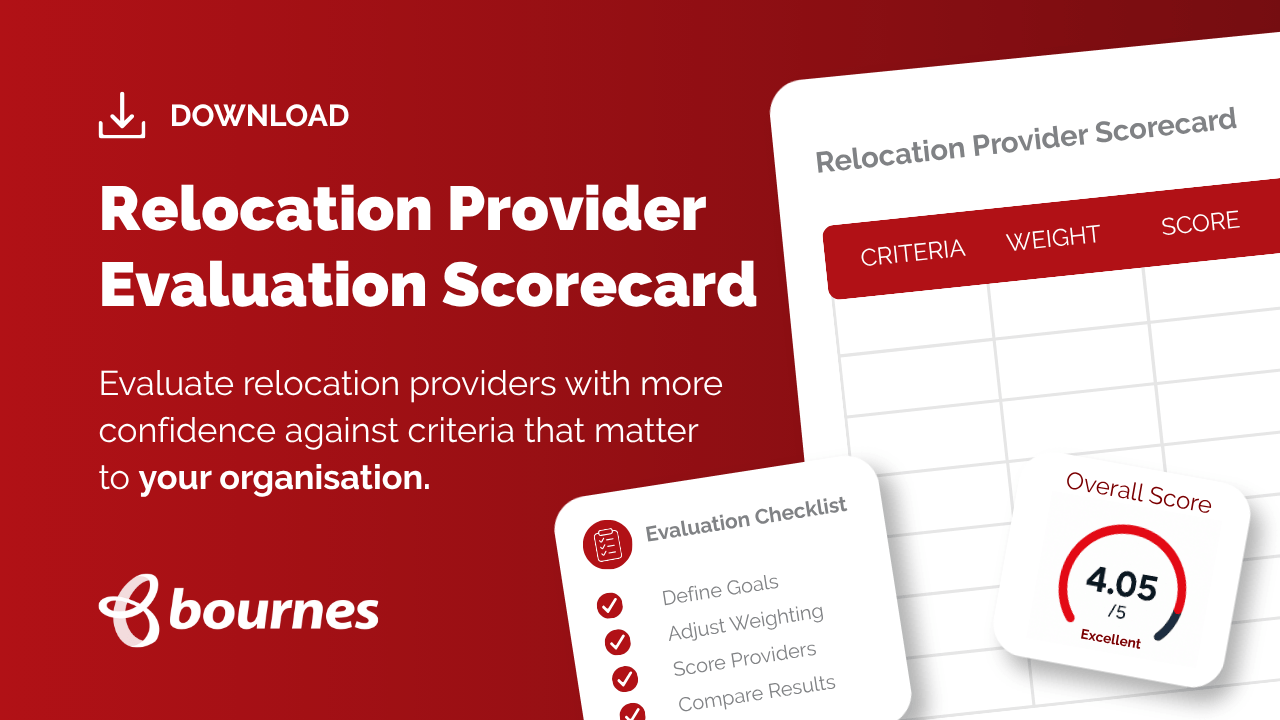
These are the exact dimensions built into our free Relocation Provider Evaluation Scorecard. The tool comes with a sensible starting point based on that practitioner input, but every weighting can be adjusted, so you can shift the balance to reflect what matters most for your organisation before you score a single provider.
Once your weightings reflect your priorities, the next step is to test real providers against them. Score any shortlisted provider, RMC, boutique, or anything in between, on a like-for-like basis, rather than on reputation or category alone.
2. Have Conversations with Potential Providers
With your priorities defined, provider conversations become far more productive. Here are five starter questions (Ahead of any formal RFP) worth asking any provider you're evaluating, whatever model they operate:
- How do you flex your service model for our highest-priority dimension? If employee experience matters most to you, ask specifically how they personalise support for individual assignees - not just what's included in a standard policy tier.
- Where does your model create trade-offs, and how do you manage them? Every model has strengths and compromises - scale can come at the expense of flexibility, automation can improve efficiency but reduce nuance. A credible provider should be able to name theirs honestly.
- What does implementation actually involve for our internal team? Speed to launch and internal resourcing needs vary significantly between providers, even within the same model type.
- How do you report on performance, and what happens when something goes wrong? Ask about visibility, escalation routes and how exceptions are handled - not just standard SLAs.
- Can you point to how you've supported an organisation with a similar profile to ours? Provider type alone won't tell you this - ask for specifics relevant to your geography, population type and priorities.
For a fuller list of questions to put to providers during a formal RFP process, see our guide to Sample Relocation RFP Questions.
Not everything that matters can be scored, either. Cultural fit, shared values, and a provider's genuine interest in your business strategy and commercial goals rarely show up on a scorecard, but they can be the deciding factor when providers are otherwise closely matched. Keep space for these intangibles alongside the more structured evaluation.

Recommendations and next steps
Choosing the right relocation support isn't about identifying a single correct model. It's about being clear on what you need, and using that clarity to evaluate options properly. In practice, that means:
- Ask the right questions internally first. Different stakeholders - HR, procurement, finance, Global Mobility - may weight priorities differently. Get a shared view before you start evaluating providers.
- Complete the self-assessment. Use it to build a defined priority profile, not to chase a model label.
- Consult a range of provider types. Early conversations often surface needs, constraints or priorities that weren't obvious at the outset - the model you expect to need isn't always the one you end up choosing.
- Consider a pilot. It's a practical way to test organisational fit and collaboration style before committing to a longer-term engagement.
Whichever combination of providers or models you land on, the organisations that get the best outcomes are the ones that go into the process with clarity about what they're solving for - not the ones that started with a category and worked backwards.
Choosing well is the first milestone, not the last. Measuring ongoing performance once a partner is in place is a related but separate exercise - we'll cover that in a future piece.
If you'd like to talk through your current relocation approach, or discuss how a combination of support might work for your organisation, our team would be happy to help.



