This guide was created to help HR and global mobility professionals gain clarity and confidence in reviewing moving quotes by breaking down where costs come from, what affects them, and how to spot potential risks.
When you understand the true scope behind the numbers, you’re better equipped to support your relocating employees with positive experiences, avoid costly surprises, and make fair, informed decisions on vendor selection.
In this article we will cover:
Most international moving quotes are structured to cover the full door-to-door journey. This typically includes every stage of the move - from packing at the origin home to delivery at destination.
For example, a move from the Midwest USA to Europe might involve:
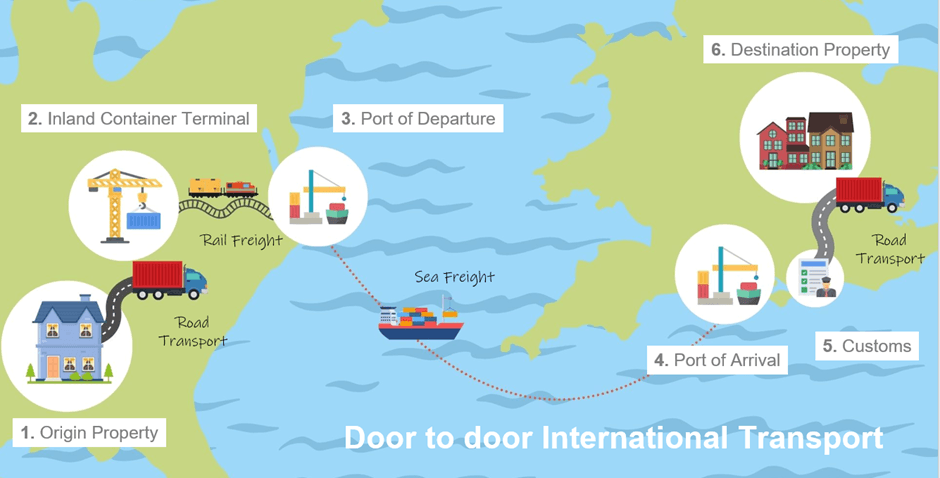
Each of these steps involves different services, partners, and cost drivers. A comprehensive quote should cover:
Understanding which services are included, and how they are broken down, helps ensure accurate comparisons and reduces the risk of hidden or unexpected fees.
Here's an example of some of the factors that may go into each part of your shipping quote:
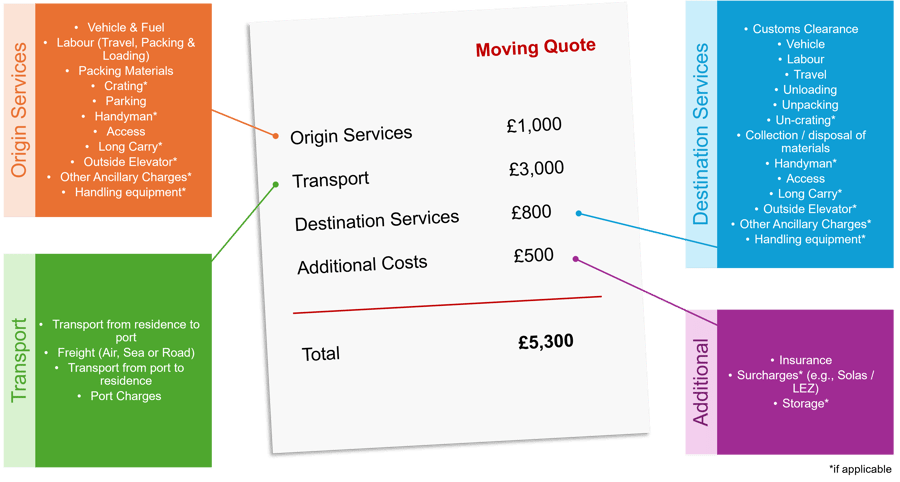

Origin costs cover everything that happens before the assignees items leave the home location. Some examples include:
The cost of origin services depends on several important factors including the amount of work involved, the time it takes, and the materials needed to get the belongings ready for transport. Because every move is unique, these elements can cause prices to vary - even for shipments within the same country or region.
This is why a pre-move survey is so important wherever possible.
It helps uncover key details, allowing the mover to plan the right resources and schedule - which means not only a more accurate cost estimate, but also reduced risk of damage and a smoother, less stressful experience for the person moving.
Let's break down some of these main drivers:
The volume of belongings being moved is one of the most significant factors influencing the overall cost of a relocation. It affects almost every stage of the process, from the time and labour required to the amount of packing materials, container space required and freight charges.
Volume is typically assessed during a pre-move survey, which helps determine not only the cost but also the most appropriate method of shipment (e.g. full container, groupage, airfreight, etc.).
Note: In some countries, particularly for airfreight, weight may be used instead of volume to calculate shipment size and pricing.

Most household goods are simple to ship, but there are some items that can add cost to your move e.g.,

While most homes have standard access, certain property-specific challenges can increase the time, resources, and cost required to complete a move.
Access restrictions are usually manageable, but they may require additional crew time or special equipment, such as an external elevator, stair carry crew, or shuttle service which will increase the cost of origin services.
Case Study: External Elevator Required Due to Access Restrictions
A customer relocating within London was moving into an apartment in a mansion block. However, the building management did not permit removal crews to use the internal stairs for delivery. As a result, an external elevator (hoist) had to be used to lift items from street level directly into the apartment via a window. This solution, while effective, was significantly more expensive than a standard stair carry due to the equipment rental, parking requirements, and-in some boroughs-the need for a special licence to operate a hoist on public pavement.

Whilst International Moves by sea and air are typically export wrapped, for UK domestic and European moves, there are typically two packing options: full export wrap and blanket wrap.
Transport is often the most visible line item but also the most variable. Costs can differ based on the mode (sea, air, or road) and container type (e.g. 20'/40') and shipping method ( Exclusive or Part load).
Transport is also the most common element to have surcharges applied.
Freight costs will vary depending on the shipping method.
International shipments move via air or sea. For sea shipments there are various options depending on requirements:
Below is a quick breakdown of the typical requirements where each might be best:
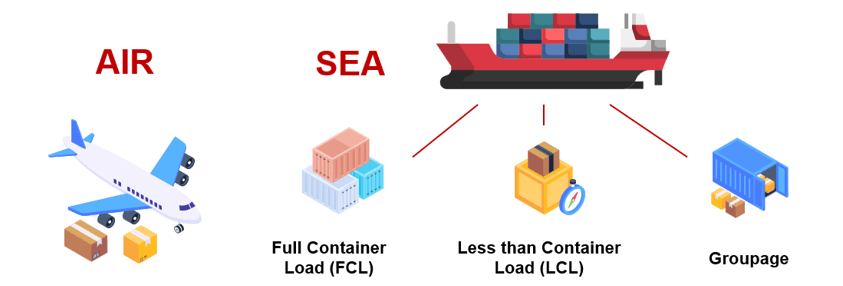
| Air | FCL | LCL | Groupage | |
|
|
||||
| SPEED | Fastest | Fastest by Sea (shipped directly following loading) | Fast (quickly consolidated before shipment) | Slower (waiting period for shared loads to be collected |
|
|
||||
| COST | High | Effective for larger moves, high for smaller moves | Only pay for space you need, but additional premium for speed | Only pay for space needed |
|
|
||||
| BEST FOR | Small urgent shipments or supplementary shipments | Full Household Moves | Small moves or assignees only moving a few key items | Small moves where assignee can be flexible on dates |
|
|
||||
| NOT FOR | Medium / Large Moves | Small Moves | Large Moves | Moves where speed or dates are critical |
When moves travel by road (within Mainland Europe, domestically, etc), these will either go as an exclusive load travelling directly from door to door, or as a part load, with smaller moves sharing the costs of transport with other customers with the same routing on a pre-determined schedule.
|
|
|
|
|
|
||
|
Dedicated Transport |
Part Load |
|
|
|
||
| SPEED |
Fastest (Typically travels direct from door to door via customs) |
Slower (Waiting period for shared loads to be collected) |
|
|
||
|
COST |
Cost effective for larger moves |
Only pay for space needed & share costs with other consignments |
|
|
||
| BEST FOR |
Full household moves |
Small moves where assignee can be flexible on dates |
|
|
||
| NOT FOR |
Small moves |
Moves where speed or dates are critical |
Aside from the method of transport explained above, there are other reasons the transport cost can vary for sea shipments:

A surcharge is an additional fee applied to the moving quote to cover specific, often external or temporary, costs that are not included in the base price. These charges are typically related to regulatory compliance, infrastructure conditions, or unusual transportation requirements and can vary by region, route, or time period.
Common examples include:
Surcharges are usually non-negotiable, vary by destination, and may change without notice, making them important to monitor separately from base quote costs.
Why aren’t Surcharges included in the main quote?
Surcharges are Variable and Unpredictable. They are typically based on:
Including them upfront could mean quoting inaccurately - too low or too high - especially for moves planned far in advance. Movers often wait to confirm these charges once the move route and timing are finalised.
Equally, because they originate from governments, ports, or carriers (not the mover), many providers list them separately to show transparency.
This separates provider pricing from external costs and avoids overcharging.
Once the shipment arrives at the destination port it will incur similar costs as at origin, including vehicle, crew, un-crating, access etc. with the addition of costs for customs clearance.
Customs clearance is the process of clearing the goods through customs ready for onward delivery including processing documentation. Costs do not include any duties or taxes that might be applicable if items are not eligible for duty free import. Your mover should help your employee to assess this during the quote stage, it is typically based on whether they are moving their permanent residence and the length of time they have been out of the country/owned their goods.
Just like at origin, destination costs are primarily driven by the volume of the shipment and the access conditions at the delivery address. The more items to unload and the more complex the property access (e.g. stairs, no parking, narrow doorways), the more time, crew, or equipment may be needed. In addition, the level of service requested at destination - such as unpacking, furniture reassembly, and set-up-will also impact the cost. Finally, local regulations, such as customs clearance processes (covered in more detail in the ‘exclusions’ section below) or labour requirements, can vary by country and affect the final price of destination services.
Typically container space on a vessel is charged in US$ or Euros, and destination services are charged in local currency, and movers will calculate the cost in £'s based on the exchange rate at the time of quoting. As there is often many weeks between a quote and a shipment loading things can change. Normally small fluctuations are absorbed by the moving company who will lose or gain profit if a rate gets better or worse, but where there are large fluctuations (e.g., in times of economic crisis) these changes in cost may be passed back to the customer. If the change is not in your favour this could mean additional charges once the actual freight or destination cost is charged to your mover.
Insurance is typically listed as a separate cost in moving quotes for several important reasons. First, the premium is typically based on the declared value of the goods, which is often not known at the time of quoting (it’s usually provided by the assignee after the quote has been accepted). Since the value can vary significantly between individuals, separating insurance from the main quote allows HR and mobility teams to accurately assess the core moving costs without the figure being skewed by personal valuations. In some cases, insurance is also an optional service, particularly if your company is not working under a contract or if the move is being quoted ad hoc. Additionally, some organisations choose to self-insure or provide their own cover.
Further reading: Understanding Household Goods Valuation for Employee Relocations.

Storage is often listed as a separate line item in international moving quotes because it’s a flexible, situational cost that can vary significantly depending on the assignee’s circumstances. Storage may be required at origin or destination to accommodate a move schedule - for example, if the assignee won’t be ready to receive delivery, is still securing housing, or wants to split the shipment between immediate delivery and longer-term storage. Charges are typically calculated on a weekly or monthly basis, and the duration may not be known at the time of quoting. For this reason, storage is usually presented as optional or provisional, giving you the ability to evaluate the core moving costs separately and only include storage if and when it’s needed.
Inspection Fees
Customs inspection fees are often excluded from the main quote or shown separately because they are unpredictable and vary by country.
In some destinations, a standard inspection fee is applied to all shipments as part of the import process and can be included as a fixed cost. However, in many countries, inspections are only carried out on a random or discretionary basis, and the length and complexity of the inspection can affect the final charge. For example, a quick visual check may be low-cost, while a full unpacking or detailed examination can result in significantly higher fees.
Because it's not always clear at the quoting stage whether an inspection will occur (or what type) it’s common for movers to treat these costs as pass-through charges, invoiced only if and when they are incurred.
Customs Duties and Taxes
While the customs clearance service (which includes preparing documentation, coordinating with customs authorities, and arranging inspections) is typically included in international moving quotes, customs duties and taxes themselves are not. These charges are set by the destination country’s Customs and Excise department and vary widely based on individual circumstances, such as the assignee’s visa/residency status, the type and age of goods, and whether the individual qualifies for duty-free import. For example, if an employee imports a non-qualifying vehicle or new items without meeting exemption criteria, duties may apply.
Since these fees are often unpredictable and outside the mover’s control, they are treated as separate, pass-through costs. However, a reputable mover will work closely with the assignee and HR team during the quote and planning process to help assess duty-free eligibility, flag any potential charges, and minimise risk of unexpected fees.
These can vary between providers so it’s always important to understand the small print.
Unless specified in the quote, the following may be excluded from the quote:
Tip: If you're unsure whether something should be included or excluded in the quote, or how to spot potential gaps, check out the Best Practices for Getting a Quote section. It outlines practical steps to ensure the move scope is accurate and helps you avoid unexpected costs later on.
You might notice that a seemingly similar move (volume/access, etc) may vary significantly between assignees, either going to different destinations or even the same destination at different times. Here’s why there might be some variation:
If you work with a panel of movers (or even during RFP processes) you might also be wondering why different providers for the exact same requirements may vary so much. Price differentials can arise due to a number of reasons including:
Demurrage: A real world case study
A household goods shipment from New York to Dublin was delayed when U.S. Customs selected the container for a random full physical inspection.
The container was pulled from its scheduled vessel, unloaded at a customs facility, and held for examination amid a backlog of inspections in New York. This resulted in missed sailing, rebooking onto a later vessel, and significant extra costs, including customs exam fees, roll-over charges, and container demurrage for exceeding terminal free time.
Despite active monitoring and efforts to expedite release, the delay and charges were unavoidable, highlighting the risk of unforeseen customs holds in international shipping.

One of the best ways to prevent surprise charges is to proactively ensure that the quote fully reflects the actual move requirements and company policy. Here are key steps to help you do that:
Ensure a like for like comparison between vendors (volume, transit time, method of shipment, services, move schedule, insurance) by ensuring everyone has understood the same scope.
Share your company’s relocation policy or any specific service expectations with the mover upfront:
This ensures quotes are aligned with what’s permitted and avoids pricing for services your programme won’t cover.
If you work with multiple suppliers, request quotes in a consistent format (even if that's just agreed elements to show) to:
Some companies include this as part of their RFP or supplier agreement.
Go through the list of what’s included and excluded in the quote. If you notice an exclusion that you believe should apply to the move, highlight it to the mover early. Likewise, if there are services you never cover, consider adding them to your policy or contract as a standard exclusion - this avoids confusion later.
If it’s not clear, ask for a detailed breakdown of:
Knowing this in advance helps prevent costly surprises and enables fair comparison between providers.
Transit insurance may be offered at different levels. Ask your mover:
Ensuring the right level of insurance protects both the assignee’s belongings and your duty of care as an employer.
Read more: How to value insurance coverage for employee household goods shipments.
Compare the Quality of the provider (including any external verification such as FIDI FAIM or ISO certification) rather than just the price.
Listen to your gut. If you’re happy that everyone is offering you the same level of service, the same level of quality and the same volume and rough price then it will be down to your personal preference. Who made you (and the assignee) feel most comfortable dealing with the process so far? Who has given you the most confidence, who do you trust? The culture of a company will determine their processes and customer experience, and your experience so far is a good indicator of what your experience will be like once you’ve booked, so, who do you want to work with?
Read more: Why you should move with a FIDI FAIM accredited International Mover
Using a trusted, pre-vetted mover (or a small panel of suppliers) brings several advantages:
If your programme uses a lump sum policy, consider recommending preferred suppliers to employees to reduce the risk of them selecting a low-cost but poor-quality provider-or one who omits key services.
Read more: Sample RFP Questions for Household Goods Providers
Read more: Guidelines for a successful move management RFP
Most international moving quotes are valid for a limited period, typically 30 to 60 days, depending on the provider and the shipping market. This is because key cost components like freight rates, fuel surcharges, and currency exchange can fluctuate. If approval is delayed past the validity period, the move may need to be requoted, and costs may increase-especially during peak seasons or in volatile markets. It's best practice to confirm the quote validity in writing and aim to approve moves promptly to secure space and pricing.
When employees manage their own move using a lump sum or cash allowance, it’s easy for them to focus on the lowest price. This can increase the risk of incomplete quotes, poor service, or hidden costs. To support a positive experience, employers should consider:
This approach balances employee choice with risk management and cost visibility.
Read more: Employee Guide to Choosing an International Removal Company
Freight costs are also influenced by factors outside the mover’s control, including:
Even with accurate paperwork, shipments can be delayed by random inspections, backlogs at customs, or incomplete declarations by third parties. In some countries, clearance is manual and subjective, which means shipments can be held longer than expected without clear explanation. Some quotes include limited free storage during clearance; delays beyond that may incur demurrage or port storage fees.
These costs are typically billed after the fact, and cannot be reasonably included in the initial quote because there’s no way to anticipate if or when they’ll apply (if they were included as standard ‘just in case’ you’d be paying for them even when not incurred, which is not cost effective).
To help minimise this risk, your mover should work with the assignee during planning to:
Ultimately though, customs control the process, and even a perfectly prepared shipment can be delayed or charged unexpectedly.
Transit insurance typically comes in two main forms:
Many providers offer variations in deductibles, valuation methods, and exclusions. For corporate relocations, it's best to opt for comprehensive, all-risk cover that protects both the employee and employer. Note: Items packed by the owner (“PBO”) may not be covered or may be insured for total loss only.
Insurance is a complex subject, so for more information please reach out.
Read more: How to value insurance coverage for employee household goods shipments.
If the destination address isn't available, access isn't as expected, or the assignee isn’t present, the mover may need to reschedule delivery-which can incur extra costs. These could include storage charges, redelivery fees, handling costs, or additional crew time. To avoid this, confirm that the assignee has a confirmed address and is prepared to receive the goods before the container arrives at destination. This is especially important for direct delivery containers where flexibility is limited.
While it’s tempting to request a quick quote upfront, accurate pricing depends on detailed information - including volume, access, special handling needs, and packing requirements. You may be able to get a ‘ball park’ budget without a survey, but a pre-move survey (in-person or virtual) allows the mover to assess the unique scope of the move and build a realistic, tailored quote. Without it, the estimate may be based on assumptions that don’t reflect the true complexity or cost, increasing the risk of unexpected charges later. For high-value or policy-compliant moves, a professional survey is an essential step.
Some costs are beyond the control of you and your mover, but here’s three tips that are within your control:
Access
The immediate area around a property-both inside and out-that affects how easily movers can load or unload. Includes driveways, stairs, elevators, narrow roads, etc. Poor access can lead to added charges (e.g., shuttle, long carry).
Accessorial (Additional) Services / Charges
Extra services outside the standard move scope, such as stair carries, appliance handling, shuttle use, or packing/unpacking services. These are typically charged separately.
BAF (Bunker Adjustment Factor)
A surcharge added to sea freight rates to cover fluctuations in the price of marine fuel (bunker fuel). Shipping lines apply BAF to protect themselves from volatile fuel costs. You probably won’t see this listed as a separate line item in quotes but it may form part of your costs.
CAF (Currency Adjustment Factor)
A surcharge applied to account for currency fluctuations between the quote currency and the operating currency of the shipping line or port. Especially relevant when international freight is billed in a different currency (e.g., USD or EUR). CAF is used to stabilise pricing in response to exchange rate volatility. You probably won’t see this listed as a separate line item in quotes but it may form part of your costs.
Crating
A custom-built wooden box used to protect fragile, high-value, or awkwardly shaped items (e.g. artwork, glass tables, TVs) during transport. Crating is typically an additional charge and may be required for insurance coverage.
Customs Clearance
The administrative process by which a shipment is approved to enter or exit a country. It involves paperwork, inspection (where applicable), and verification of eligibility for duty-free status. Often included in quotes as a service fee, but duties/taxes are charged separately by local customs authorities.
Customs Duties / Import Taxes
Government-imposed fees applied to imported goods that don’t meet duty-free criteria (e.g. new items, ineligible vehicles). These are not included in moving quotes, as they vary by country, item, and individual eligibility.
Declared Value
The total value assigned to household goods for insurance purposes, usually based on replacement cost or depreciated value. Determines the level of coverage under transit insurance.
Demurrage
Demurrage is a penalty fee charged by the shipping line when a container isn’t collected or returned within the allowed free time at the port or terminal. This can occur due to customs delays, missing paperwork, or scheduling issues. It’s charged per day and can escalate quickly if not resolved promptly.
Door‑Curbside
A delivery option where items are delivered only to the outside of the destination property, not carried inside.
Door‑to‑Door Service
A comprehensive service where items are collected from and delivered inside the homes at both origin and destination. Reduces handling and coordination.
Export Wrap / Full Export Packing
A professional-grade packing service using heavy-duty materials (e.g. bubble wrap, paper, cardboard) to protect items for international or long-term storage transit. Recommended for warehouse or containerised moves.
External Elevator
An external elevator (also called a furniture lift) is a mechanical platform lift used outside a building to move goods through upper-floor windows or balconies, especially where internal staircases or lifts are too narrow or unavailable. The cost includes equipment rental, setup, and specialist operators, and is often required in dense urban areas.
Freight Charges
Costs related to transporting goods via ship, truck, or air. In sea shipments, this includes container handling, loading, and the sea voyage itself. Often the largest component of the quote and impacted by container size, route, and fuel surcharges.
Fuel Surcharge
A variable fee added to offset fluctuations in fuel prices. This may be updated frequently and shown as a separate line item to reflect real-time market conditions.
Insurance (Transit Insurance / Move Protection)
Optional coverage to protect the assignee against loss or damage during the move. Different levels of cover are available (e.g. full replacement vs. limited liability), and assignees are usually required to declare the value of their belongings for coverage.
Long Carry
A long carry fee is charged when there’s a significant distance between the truck and the residence, usually beyond a standard allowance (e.g., more than 15–20 meters). This might occur if parking is not available directly outside the property, requiring the crew to manually carry goods over a longer distance.
Port Charges / Terminal Handling Charges (THC)
Fees applied by ports or terminals for the handling and processing of containers. Often not included in some quotes unless specifically requested, and can vary widely between countries.
Port Storage Fee
A charge applied when a shipment stays at the port longer than the free storage period (usually a few days). Port storage is billed by the port operator and can quickly accumulate if paperwork or customs clearance is delayed.
Shuttle
A smaller vehicle used when a full-size truck or container can’t access the property due to narrow roads or parking restrictions. Adds cost and handling time.
SIT (Storage‑in‑Transit)
Temporary storage of goods during the move process-either before delivery or due to delays. May incur additional daily storage and handling fees.
Stair Carry
A stair carry charge applies when movers need to carry items up or down flights of stairs, typically beyond a certain threshold (e.g., more than one or two floors). It compensates for the added time, physical effort, and risk involved when an elevator isn’t available or usable. This can apply at either the origin or destination.
Tranship / Transhipment
The process of transferring goods from one vessel (or mode of transport) to another during the shipping journey. This usually occurs at a hub port and can increase transit time and the risk of delay or damage, especially if not well-managed.
Warehouse Handling
Charges for moving goods into, out of, or within a warehouse during the moving process. This includes unloading from trucks, placing items in storage, reloading, and preparing for onward delivery. These costs are often incurred when goods cannot go directly from origin to destination.